
All-on-4 vs All-on-6: Which Full-Arch Implant Option May Suit You?
Compare All-on-4® with fixed full-arch treatment using six Implants, including bone, loading, grafting, temporary teeth, maintenance and treatment planning.
Me Tri Dental Clinic
October 3, 2026
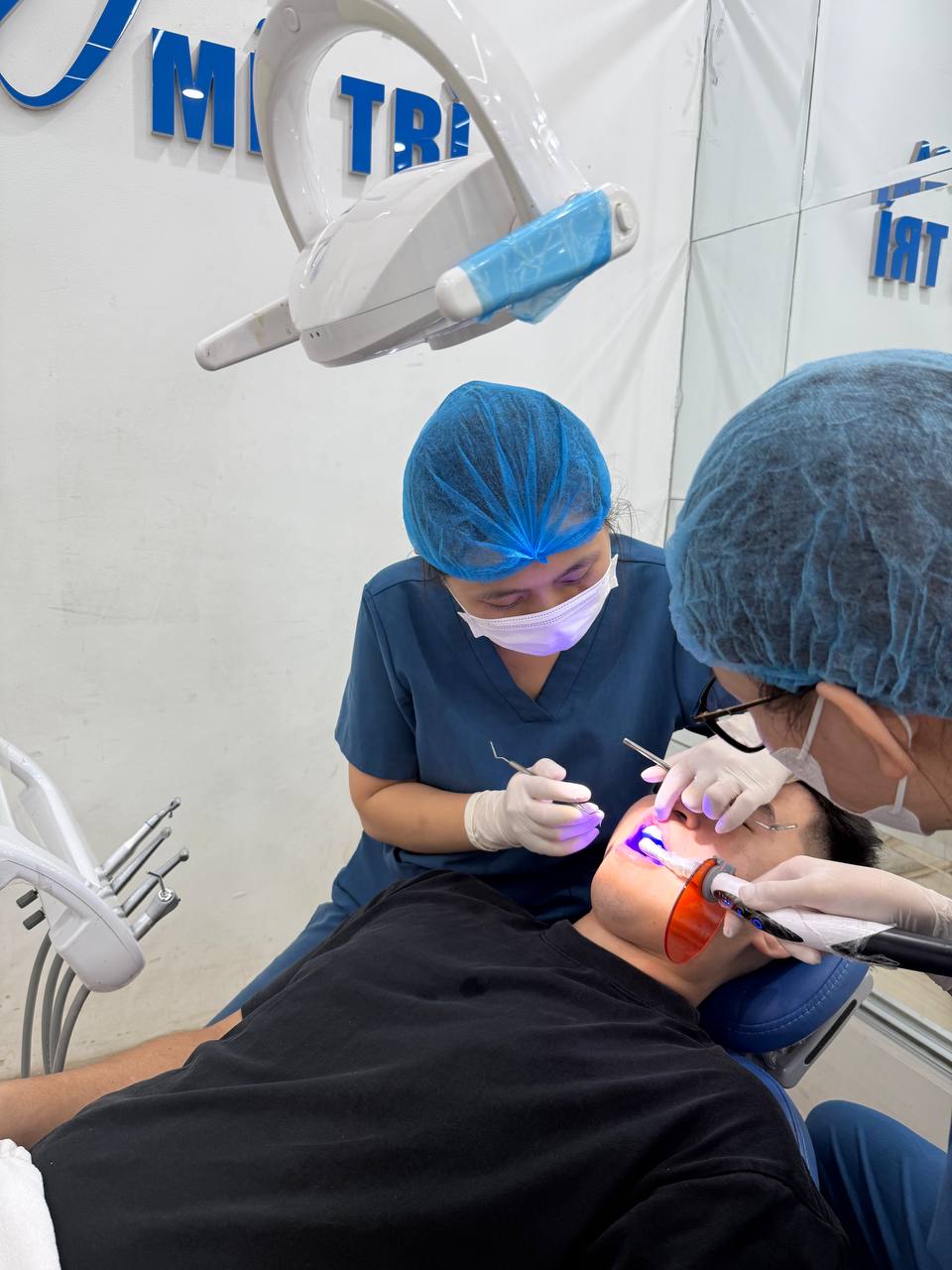
All-on-4® and six-Implant full-arch treatment are both fixed options for replacing a complete upper or lower dental arch. All-on-4® uses four strategically positioned Implants, while a six-Implant plan uses six Implant supports. Neither is automatically better.
All-on-4® can be useful when a four-Implant distribution provides appropriate support and makes effective use of the available bone. A six-Implant design may be considered when the anatomy, available bone, restorative plan and expected loading support a six-Implant distribution.
The number should not be selected simply because six sounds stronger or because four sounds less invasive. The dentist should first plan the intended full-arch restoration and then determine the Implant number and positions required to support it.
Me Tri Dental Clinic provides both the official Nobel Biocare All-on-4® treatment concept and fixed full-arch rehabilitation using 6 Implants. There is currently no fixed public package price for either treatment.
In this article, All-on-6 is used as a familiar search term for a fixed full-arch restoration supported by six Implants. It should not be interpreted as the name of a confirmed proprietary treatment system equivalent to Nobel Biocare's All-on-4® treatment concept.
If you need a broader introduction to the process, see full-arch Dental Implant treatment in Hanoi. For clinic treatment information, see Dental Implants in Hanoi.
All-on-4® vs six-Implant full-arch treatment at a glance
The table describes structural differences, not a ranking. Either approach must be planned around the individual arch and intended final restoration.
Considering fixed full-arch Implant treatment? The Implant number should be confirmed after the dentist evaluates the remaining teeth, CBCT, available bone, bite and planned final restoration.
What is the All-on-4® treatment concept?
All-on-4® is the official Nobel Biocare full-arch treatment concept using four strategically positioned Dental Implants to support a fixed restoration replacing a complete upper or lower dental arch.
At a high level, two anterior Implants are generally positioned more vertically, while two posterior Implants may be tilted according to the treatment concept and the patient's anatomy. The purpose is not to follow one identical angle in every case, but to create a useful distribution of support for the full arch.
Why are the posterior Implants tilted in All-on-4®?
Tilting the posterior Implants can help use the available bone strategically, increase the distance between Implant supports and avoid certain anatomical structures in appropriate cases.
This does not mean tilted Implants are always superior, that tilting always eliminates grafting, or that every patient receives the same Implant angle.
Does All-on-4® mean you will not need a bone graft?
No.
The treatment concept can make strategic use of available bone and may reduce the need for grafting in selected cases, but it does not guarantee a graft-free treatment.
Whether grafting is needed depends on the available bone, intended Implant positions, extraction sites, anatomy and restorative plan. A dentist should not promise no bone graft before clinical assessment and CBCT planning.
What is fixed full-arch treatment using 6 Implants?
This approach uses six strategically positioned Dental Implants to support a fixed restoration replacing the complete upper or lower arch.
The exact Implant locations depend on the available bone, restorative design, arch anatomy, planned tooth positions, bite, Implant distribution and cleaning access. It should not be assumed that all six Implants are placed vertically or in one fixed pattern.
Are six Implants automatically stronger than four?
Not automatically.
Six fixtures provide more Implant support points, but the clinical value of those additional fixtures depends on their positions, the available bone, Implant stability, arch shape, prosthetic design, bite, expected forces, cantilever, restorative design and long-term maintenance.
Implant count alone does not determine the performance of a full-arch restoration.
More support points may change how forces are distributed, but full-arch biomechanics cannot be reduced to more Implants equals a better outcome. Implant position, primary stability, the prosthetic framework, opposing teeth, bruxism and the complete restorative design all matter.
Does using only four Implants make All-on-4® weaker?
No such conclusion can be made from Implant count alone.
The All-on-4® concept is specifically designed as a four-Implant full-arch treatment. Clinical research has shown that appropriately selected fixed full-arch cases can be rehabilitated with either four or six Implants. That evidence should not be interpreted as proof that the two designs are identical or equally suitable for every patient.
The important question is whether the selected Implant distribution appropriately supports the planned restoration in that patient's anatomy.
What is the real difference between four and six Implants?
The practical difference is not simply two extra Implant fixtures. It is a different distribution of Implant support for the planned full-arch restoration.
That distribution affects planning for:
- available bone
- Implant position
- arch span
- restorative space
- loading
- possible cantilever
- surgical access
- cleaning access
- future maintenance
A cantilever is part of the restoration that extends beyond the last supporting Implant. Its design may be influenced by posterior Implant position, arch anatomy, bite and restorative requirements. There is no single cantilever rule that can be applied to every full-arch case.
How does available bone affect All-on-4® vs six-Implant planning?
Every planned Implant requires appropriate bone at its intended position.
All-on-4® may sometimes use four strategic locations when other areas have less favorable anatomy. A six-Implant design requires six clinically useful Implant positions.
This does not mean six Implants require more grafting in every case or All-on-4® avoids grafting in every case. CBCT helps the dentist assess the possible Implant positions, nearby anatomy and the distribution of available bone.
For a six-Implant plan, simply having enough total bone volume somewhere in the arch is not enough. The dentist needs six positions that work with the planned tooth positions, spacing, loading, hygiene access and surrounding anatomy.
Does the choice differ in the upper jaw?
It can, but there is no automatic rule.
Full-arch planning in the upper jaw may consider sinus anatomy, bone distribution, bone characteristics, smile line, lip support, restorative space and Implant distribution.
Six Implants are not always required in the upper jaw, and All-on-4® is not always preferred. Either configuration may be considered when it appropriately supports the confirmed restorative plan.
What about the lower jaw?
Lower-jaw planning may consider mandibular nerve anatomy, bone distribution, arch shape, restorative space, bite and Implant distribution.
A simple rule such as four for the lower jaw and six for the upper jaw is too simplistic. The number and positions need to follow the anatomy and restoration.
Why does Implant distribution matter as much as Implant number?
Six poorly positioned Implants do not automatically create a better restoration than four appropriately positioned Implants. The reverse should not be assumed either.
The restorative design needs Implant supports positioned to work with the intended tooth positions, bite, arch shape, loading, accessible cleaning and available bone.
Position and distribution matter alongside fixture count.
Does having six Implants provide a backup if one Implant has a problem?
A six-Implant restoration has more Implant supports, but a problem affecting one Implant still requires assessment of the entire restorative system.
Whether the restoration can continue functioning, needs modification or requires another treatment depends on the affected Implant's position, stability and the prosthetic design. Six Implants should not be described as two backup Implants, and an All-on-4® restoration should not be described as automatically failing if one Implant develops a problem.
Is All-on-4® less invasive because it uses fewer Implants?
Not necessarily.
Four fixtures means fewer Implant placements than six, but total surgical complexity may depend more on extractions, bone condition, Implant positioning, grafting, sinus procedures, soft tissue management and the overall extent of surgery.
Fixture count alone should not be used as a measure of surgical difficulty.
Likewise, six Implant sites involve six fixtures, but a well-planned six-Implant case with favorable bone may not necessarily be more complex overall than a four-Implant case requiring additional surgical procedures.
Can both options have fixed temporary teeth on the same day?
Potentially, yes.
A fixed temporary full-arch restoration may be provided early, including on the day of surgery, when the confirmed treatment plan achieves appropriate primary Implant stability and meets the conditions for immediate loading. This principle can apply to either four- or six-Implant full-arch designs.
Primary stability describes the mechanical stability of an Implant immediately after placement. It is one of the factors considered when deciding whether a temporary fixed restoration can be connected early, but it is not the only factor.
Same-day fixed teeth are a temporary restoration, not the final full-arch prosthesis.
Receiving temporary teeth immediately does not mean the Implants have completed osseointegration. The usual pathway still includes healing and a later definitive restorative workflow.
Immediate-loading eligibility depends on the stability and distribution of the complete Implant plan, not simply whether four or six fixtures are used.
Is All-on-4® faster than six-Implant treatment?
Implant count alone does not determine the total treatment time.
Both pathways can involve assessment, extraction when required, Implant placement, a temporary restoration when appropriate, osseointegration and final restorative stages. Additional procedures can extend either pathway.
For a broader explanation of biological healing and treatment stages, see the Dental Implant treatment timeline.
Neither option should automatically be presented as a one-trip complete treatment. Even when fixed temporary teeth are provided on surgery day, Implant healing continues and the final full-arch restoration is completed later.
Which option is more likely to need bone grafting?
There is no universal answer.
All-on-4® may allow strategic Implant positions that reduce the need for grafting in selected cases. Six-Implant treatment may be possible without grafting when six suitable sites are available.
Either option may require grafting or sinus treatment when the planned Implant positions lack adequate bone. The need for these procedures should be determined from the confirmed Implant distribution rather than from the number four or six alone.
Is All-on-4® cheaper than six-Implant treatment?
Do not assume this from Implant count alone.
Me Tri Dental Clinic currently has no fixed public All-on-4® package price and no fixed public six-Implant full-arch package price.
A full quotation may depend on the remaining teeth, extractions, Implant number and positions, Implant system, temporary restoration, definitive restoration, grafting or sinus treatment, surgical complexity, biomaterials when required and follow-up.
Both require individual full-arch quotations after examination, CBCT and complete surgical/restorative planning.
A full-arch treatment is a complete surgical and prosthetic rehabilitation, not simply four or six copies of a single-tooth Implant package. The price should therefore not be calculated by multiplying a single-Implant price by four or six.
Does choosing All-on-4® or six Implants mean all remaining teeth should be removed?
No.
The dentist should first assess whether remaining natural teeth can reasonably be preserved. Full-arch replacement should not begin with the assumption that every tooth must be extracted.
This principle applies equally to both options. Implant treatment should not be presented as preferable to natural teeth that can be predictably maintained.
Who may consider either option?
Potential candidates may include people with a completely edentulous arch, a complete removable denture, most teeth missing, or remaining teeth that have been clinically assessed as having a poor prognosis and who want a fixed full-arch replacement.
Candidacy still depends on the complete clinical picture, including bone, anatomy, gum and periodontal condition, general health, medications, smoking, oral hygiene, bite, restorative space, parafunction and the ability to maintain the restoration.
Active periodontal disease should be controlled before Implant placement.
Diabetes does not automatically exclude either full-arch option. Glycemic control and overall health are relevant to surgical planning and healing.
Smoking increases Implant and peri-Implant risk and should be discussed when planning either approach. Using six Implants does not cancel that risk, and smoking alone does not determine whether four or six should be used.
Bruxism or a heavy bite may influence Implant and restoration planning, loading, prosthetic design and maintenance. Six Implants should not be treated as an automatic solution for heavy functional forces.
Is All-on-4® easier to clean than a six-Implant restoration?
Not automatically.
Both are fixed full-arch restorations that require cleaning around Implant-supported areas, along the gum/restoration interface and underneath accessible prosthetic areas.
Cleaning difficulty depends on the restoration contours, Implant positions, tissue shape, available access and patient dexterity. Two extra Implant supports do not by themselves determine hygiene difficulty.
Does either option require less maintenance?
Neither should be assumed to require less maintenance.
Both need daily hygiene, routine dental review, peri-Implant tissue monitoring, professional maintenance, bite assessment and monitoring of prosthetic components.
Maintenance depends on the complete restoration rather than Implant count alone.
Both four- and six-Implant restorations can experience wear, fracture, loosening, component issues and other restorative maintenance needs. Both also require monitoring for inflammation around Implant tissues, bone changes and Implant integration or stability.
No Implant configuration eliminates biological or prosthetic complications.
What actually determines whether four or six Implants may be considered?
This table is a planning framework, not an automated treatment selector.
When might four or six Implants be discussed?
None of these scenarios automatically selects a treatment. They show why the restorative plan needs to come before the fixture count.
How does the dentist decide between four and six Implants?
A practical planning sequence is:
- Determine whether remaining teeth can be preserved.
- Define which arch requires treatment.
- Review medical history and medications.
- Assess gum and periodontal condition.
- Review CBCT and available bone.
- Plan the intended final tooth positions.
- Evaluate restorative space.
- Evaluate bite and loading.
- Identify clinically useful Implant positions.
- Determine whether four or six Implant supports fit the restorative design.
- Assess whether grafting or sinus treatment is required.
- Assess immediate-loading eligibility.
- Plan the temporary restoration.
- Prepare the complete surgical and restorative quotation.
- Confirm the final plan with the patient.
The core principle is simple: plan the restoration first, then choose the Implant distribution.
Choosing more Implants simply for reassurance is not an adequate treatment-planning principle. Six Implant sites should be used when they contribute meaningfully to the confirmed restorative design and can be positioned appropriately.
Choosing four solely to minimize Implant count is not an adequate planning principle either.
Can you simply choose four or six Implants?
Patient preferences are part of treatment planning, but Implant number should not be chosen like a product upgrade.
The dentist should explain the clinically appropriate alternatives, their trade-offs, additional procedures, treatment stages, maintenance and cost. The patient and dentist can then make the treatment decision together.
If a patient prefers fewer Implants, the dentist still needs to determine whether four strategically positioned Implants provide appropriate support for the planned arch. All-on-4® should not be promised simply because someone hopes for less surgery or a lower price.
What should international patients know when comparing the options?
Existing panoramic X-rays, CBCT scans, treatment plans, extraction history and previous Implant records can support a preliminary discussion before travel.
However, final selection between a four- and six-Implant full-arch design requires appropriate clinical assessment and current treatment planning.
If you are preparing records before travel, see dental records to send before Implant treatment abroad.
Implant count alone does not determine the travel schedule. Both pathways may include a surgical phase, a temporary restoration, healing, a later restorative phase and follow-up. Neither should automatically be described as a complete one-trip treatment.
Can full-arch treatment be discussed in English?
Yes. Consultation, treatment planning, cost explanation, aftercare and follow-up communication are available in English at Me Tri Dental Clinic.
This does not mean every member of staff is a native English speaker. The important point is that the treatment plan, quotation and follow-up instructions can be discussed in English.
How much do All-on-4® and six-Implant treatment cost in Hanoi?
Me Tri Dental Clinic does not currently publish a fixed package price for either the All-on-4® treatment concept or fixed full-arch rehabilitation using 6 Implants.
A complete quotation depends on factors such as:
- remaining teeth
- extraction requirements
- Implant number and positions
- Implant system
- temporary restoration
- final restorative design
- bone grafting
- sinus treatment
- biomaterials
- surgical complexity
- follow-up requirements
The clinic should not use single-tooth Implant pricing as the basis for a full-arch package calculation.
Published clinic prices exclude VAT. VAT is added only when the patient requests a VAT invoice. Because there is no fixed public full-arch package price, VAT is a secondary detail rather than a reason to estimate the treatment total in advance.
What should you compare in two full-arch treatment plans?
When comparing quotations, look beyond the number of Implant fixtures.
- Which remaining teeth are being preserved or extracted?
- Which arch is being treated?
- How many Implants are proposed?
- Where will they be positioned?
- Why is that Implant number being recommended?
- What Implant system is planned?
- Is grafting required?
- Is sinus treatment required?
- Is an immediate fixed temporary restoration planned?
- What happens if immediate loading is not possible?
- What temporary restoration will be used?
- What final restorative design is proposed?
- What is included in the quotation?
- What could be additional?
- What follow-up is required?
- What Implant fixture warranty applies?
- What maintenance will be required?
This is more useful than comparing fixture count alone.
Any published warranty period should be interpreted according to what it actually covers. An Implant fixture warranty does not automatically apply to the complete full-arch prosthesis or every restorative component.
Frequently asked questions
What is the main difference between All-on-4® and All-on-6?
All-on-4® uses four strategically positioned Implants to support a fixed full-arch restoration. A six-Implant plan uses six Implant supports. The appropriate number depends on the complete surgical and restorative plan rather than Implant count alone.
Is All-on-6 better than All-on-4®?
Not automatically. More Implant fixtures do not by themselves make a full-arch treatment better. Bone, anatomy, Implant distribution, bite, restorative design and maintenance all need to be considered.
Is All-on-4® weaker because it only uses four Implants?
Implant count alone does not determine whether the restoration is appropriately supported. All-on-4® is specifically designed as a four-Implant fixed full-arch treatment concept for appropriately selected cases.
Are six Implants stronger than four?
Six fixtures provide more Implant support points, but the clinical benefit depends on where those Implants can be placed and how they support the planned restoration. Six is not automatically better.
Does All-on-4® always avoid bone grafting?
No. Strategic Implant positioning can reduce the need for grafting in selected cases, but grafting can still be required.
Does treatment with six Implants require bone grafting?
Not automatically. Grafting is considered when the bone at a planned Implant site is insufficient for the confirmed treatment plan.
Can both options provide same-day fixed teeth?
A fixed temporary full-arch restoration may be provided on surgery day in selected cases when appropriate primary Implant stability and the treatment plan permit immediate loading.
Are same-day teeth the final teeth?
No. They are temporary fixed teeth used during the healing phase. The final full-arch restoration is completed later according to the confirmed treatment plan.
Is All-on-4® faster than six-Implant treatment?
Not necessarily. Implant count alone does not determine treatment duration. Healing, extraction, grafting, Implant stability and the restorative workflow affect the timeline.
Is All-on-4® cheaper than six Implants?
There is no fixed public price comparison at Me Tri Dental Clinic. Both treatments require individual quotations after full-arch planning, and cost cannot be calculated from Implant count alone.
Can I calculate All-on-4® by multiplying four single-Implant prices?
No. Full-arch rehabilitation has its own surgical and restorative design and should not be calculated by multiplying single-tooth Implant packages.
Is six Implants safer if one Implant fails?
A six-Implant restoration has more Implant supports, but a problem with any Implant still requires assessment of the complete restoration. Six Implants should not be described simply as providing backup fixtures.
Can I choose six Implants because I want the strongest option?
Patient preference is important, but the dentist should first determine whether six Implant positions contribute meaningfully to the planned restoration. More fixtures are not automatically a clinical upgrade.
How will I know which option suits me?
The dentist assesses the remaining teeth, CBCT, bone distribution, anatomy, bite, restorative space, Implant positions, loading, hygiene and medical factors before discussing whether a four- or six-Implant plan is appropriate.
Choose the full-arch design from your anatomy and restorative plan, not simply from the Implant count
Me Tri Dental Clinic provides both the official Nobel Biocare All-on-4® treatment concept and fixed full-arch rehabilitation using 6 Implants. Examination and CBCT are used to assess the remaining teeth, available bone, Implant positions, bite and intended final restoration before the dentist explains which treatment plans are clinically appropriate.
Related services
Related topics
Full-Arch Dental Implants in Hanoi: Treatment Options Explained
September 26, 2026
Individual Implants or an Implant-Supported Bridge for Several Missing Teeth?
September 20, 2026
Dental Implant vs Dental Bridge for One Missing Tooth
September 13, 2026
Need a treatment plan that fits your case?
Book a consultation with our team in Me Tri, Hanoi, or review services before your visit.